

Child Wellbeing Must Come Before Economic Short-termism
Leading advocates and academic researchers on child development are warning that the UK risks repeating mistakes seen in Finland and Denmark, where family policies designed to maximise parental employment may be having unintended consequences for children's wellbeing.

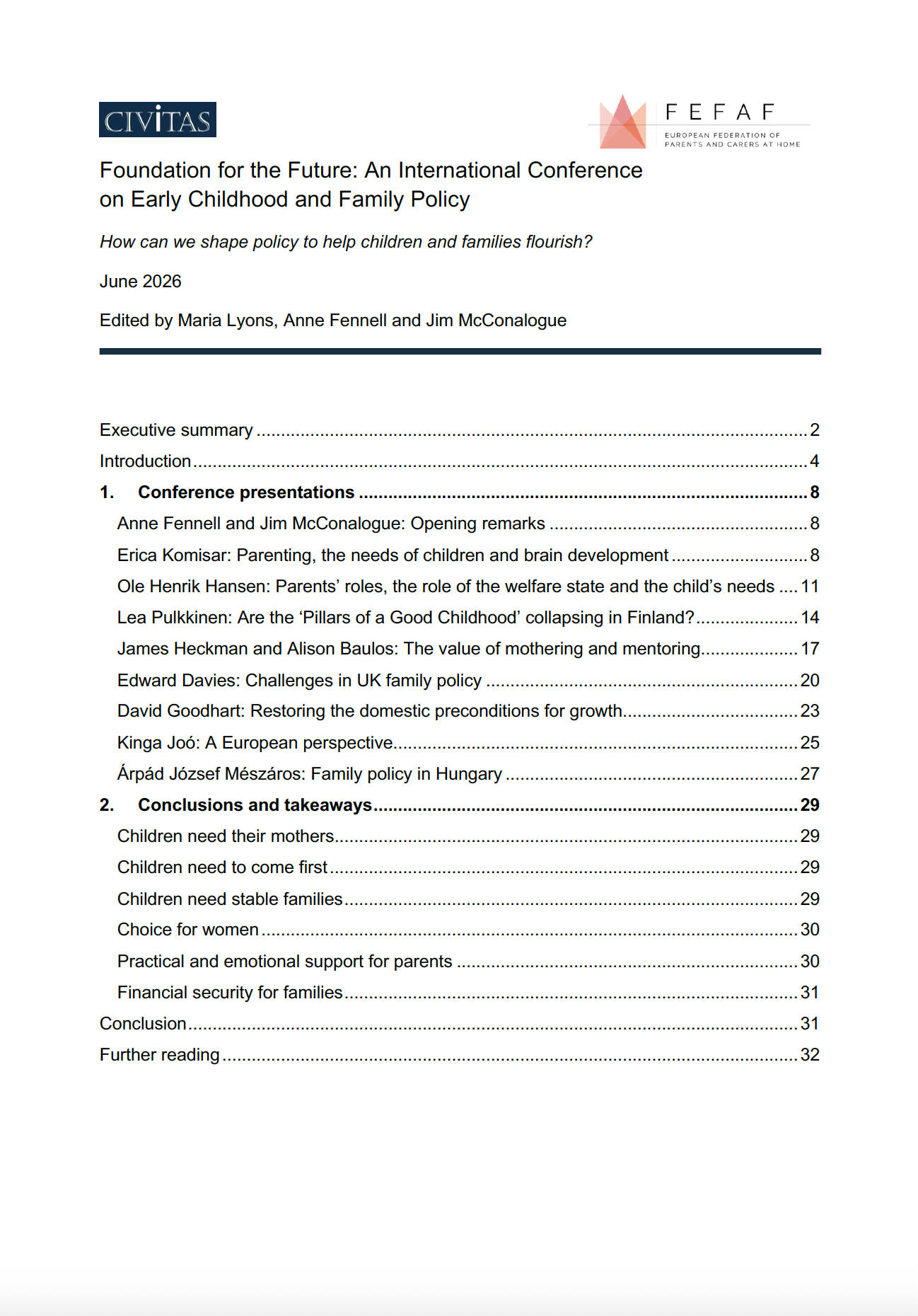
The warning comes in a new report published by the think-tank Civitas following the Foundation for the Future conference, convened in London by the European Federation of Parents & Carers at Home (FEFAF) and Civitas. The conference brought together international researchers to examine growing concerns about child wellbeing, family life and early years policy.
The report, Foundation for the Future, highlights three troubling trends across many Western countries:
The portrayal of children as barriers to economic participation;
The undervaluing of parenting and unpaid care, which is invisible in GDP reports and regarded as economic inactivity;
A lack of understanding or even interest in the impact of childcare policies on children's development. Institutional childcare is being promoted for increasingly young children and for increasing hours.
Lea Pulkkinen, Professor of Psychology Emerita at the University of Jyväskylä, argues that in Finland, the ‘ten pillars of a good childhood’ are being eroded by an ideology of global competition. These pillars include creative play, physical activity, access to nature, growing independence, strong community support and, crucially, stable caregivers. Over the past two decades, economic competition has driven a push for early cognitive development and full-time parental workforce participation, often at the expense of children’s social and emotional needs. While their rights are legally recognised, children are increasingly being left alone both physically and emotionally. Pulkkinen states: “In Finland, economic values increasingly dominate, replacing educational philosophy and causing the erosion of childhood”. Lea suggests that we need to be aware of these harmful trends in order to restore the balance. Public policy and community life need to refocus on the needs of children and on respect for parenting.
“Only 13 per cent of daycare settings for children under two were judged to provide a good quality service”
Similar concerns were raised by Professor Ole Henrik Hansen of Jönköping University, who pointed to rising levels of stress, anxiety and loneliness among children across Scandinavia. He highlighted a Danish government study which found that only 13 per cent of daycare settings for children under two were judged to provide a good quality service.
Professor Hansen also discussed strands of research linking long hours in daycare with elevated cortisol levels in some young children, a recognised indicator of stress.
The report argues that the UK is increasingly moving in the same direction, with growing pressure on parents to return to work when children are very young and increasing reliance on institutional childcare.
Finland and Denmark provide a cautionary tale for us in the UK. The conference, Foundation for the Future, was convened because in our extensive campaigning both for Mothers at Home Matter and for FEFAF – here in the UK, at the UN and across Europe – not one politician, academic or daycare lobbyist could answer the simple question: ‘What evidence is there that these policies pushing very young children into daycare for long hours are good for the child?’
“Not one politician, academic or daycare lobbyist could answer the simple question: ‘What evidence is there that these policies pushing very young children into daycare for long hours are good for the child?’”
The conference also heard from psychoanalyst Erica Komisar and Nobel Prize-winning economist James Heckman.
Komisar, psychoanalyst and author of Being There: Why Prioritizing Motherhood in the First Three Years Matters, drew on both clinical experience and extensive neurobiological research to demonstrate that the presence and engagement of a mother, father, or a constant family caregiver is a key determinant of long-term positive outcomes for children. The first 1,000 days of life represent a critical window for brain development, during which babies are highly sensitive to their environment. Mothers in particular play a vital role in buffering stress, regulating emotions, and fostering a sense of security—functions akin to a baby’s central nervous system.
Heckman argued that policymakers have consistently underestimated the value of parenting and family life. ‘The labour market has become the benchmark of success. This narrow approach ignores the non-market benefits of stable nurturing environments and the value of a mother and of household activity. It fails to see child development as a major household output’, Heckman told delegates, ‘despite it being fundamental to successful child outcomes and developing human potential.’
The report concludes that improving children's outcomes depends not simply on investment in services and institutions but on supporting parents and strengthening family relationships. To build healthy and prosperous nations, governments need to invest in children, which means trusting parents, investing in targeted support for those that need help, and to avoid creating perverse subsidies working against the natural instincts of families and communities in which mothers want to provide care at home in the early years.

The political climate in the UK seems too eager to look away from the needs of children and the wishes of mothers, but this family-blind orthodoxy cannot prevail for very much longer. The economics of collapsing fertility and the crisis of mental health will entail a shift in cultural attitudes and the rejection of the role of mother at the heart of this short-termism will be forced to take a dramatic turn.
Sponsors included:



MAHM campaigns for:
Childcare subsidy to follow the child with parents allowed to chose whether they use it to stay at home, give it to grandparents, childminder or external setting.
Taxation should fall fairly on those who stay at home and those who work.
Public examination on short and long term needs of children (and the effect on infants of long hours in external settings).
Recognition of value of unpaid care (estimated at £77 billion by Carers UK).
Are you a MAHM member yet?
There are many benefits to being a Mothers At Home Matter member! Your support is invaluable to help us shout louder about fairer taxation for families and acknowledge the choices 21st-century mothers want for their children.